
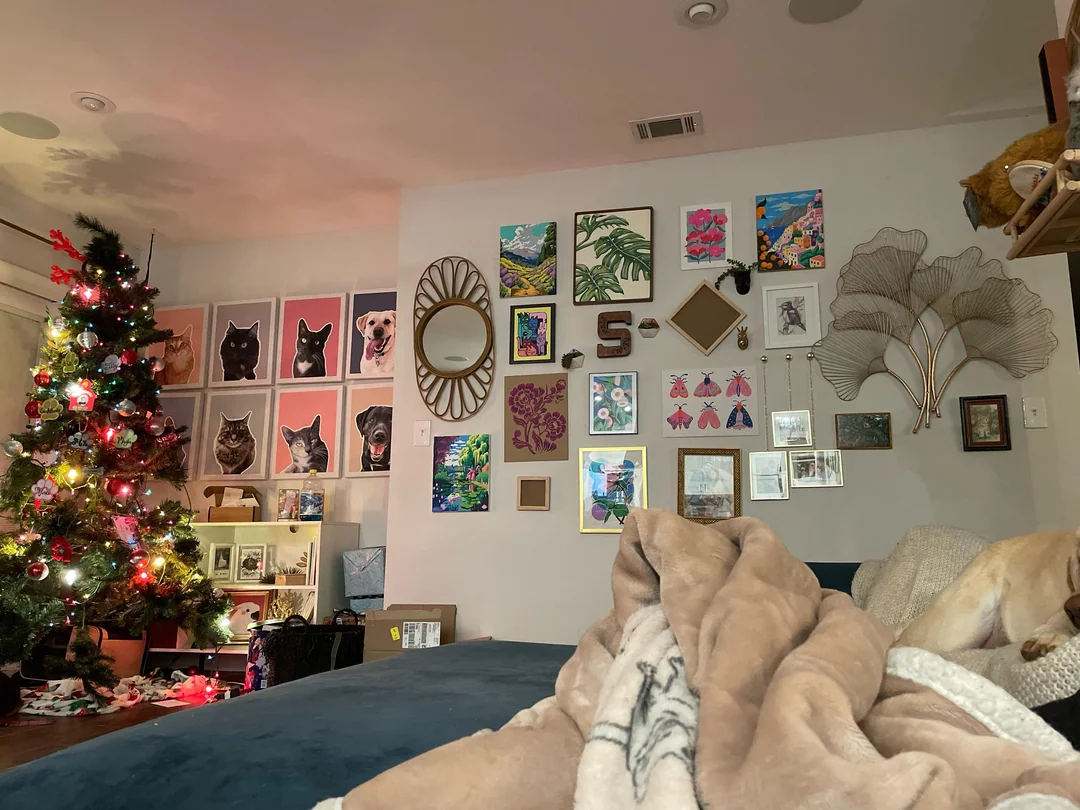
Wall decor becomes crowded when the eye has nowhere to rest, not simply because there are too many meaningful pieces. Family photographs, artwork, travel finds, posters, and keepsakes can all stay in the room. The better solution is to organize them into clearer visual relationships so personality remains visible without every piece competing equally.
Decide Which Pieces Deserve Attention
Start by identifying the wall pieces you would notice first if the room were empty. Those should become the anchors of the display.
A large painting, sentimental photograph, handmade textile, or unusual print can lead the composition. Reviewing different home decor approaches may help clarify how one dominant piece can organize several smaller items around it rather than letting everything carry the same visual weight.
Remove Competition Around the Focal Point
A strong focal piece needs enough open wall around it to remain dominant. If several frames touch visually or sit too close together, the eye begins reading them as one dense patch.
Temporarily remove neighboring pieces and view the wall from across the room. Often, fewer surrounding items make the favorite artwork feel more significant.
Turn Scattered Pieces Into Defined Groups
Random spacing usually looks busier than a larger but organized gallery wall. Group related pieces by subject, frame finish, color palette, or personal meaning.
For a softer appearance, ideas from relaxed living spaces can be useful when deciding how much wall should remain uncovered. A room tends to feel calmer when artwork occupies clear zones instead of spreading across every available surface.
| Crowded Pattern | Simpler Alternative | Result |
|---|---|---|
| Many tiny frames | One grouped gallery | Stronger focus |
| Decor on every wall | One feature wall | More breathing room |
| Mixed random spacing | Consistent gaps | Cleaner structure |
| Equal-size pieces | Varied scale | Better hierarchy |
Connect Wall Decor With the Room
Artwork shouldn’t feel disconnected from furniture beneath it. A collection centered over a sofa, console, desk, or bed tends to look more intentional because the furniture provides a visual boundary.
Colors and materials can also connect wall decor with the wider environment. Even outdoor design inspiration can suggest earthy palettes, botanical forms, and natural textures that translate well into framed prints or decorative wall objects.
Keep the Relationship Loose
Matching everything exactly can make a room feel staged. The artwork doesn’t need to repeat the sofa color perfectly or share identical finishes with every piece of furniture.
One or two connections are enough. A black frame might echo a lamp base, while a warm wooden frame relates to a nearby table.
Rotate Instead of Displaying Everything
People often keep every favorite item visible because storing meaningful decor feels wasteful. Rotation solves that problem.
Keep a smaller wall collection on display and store the rest safely. Change several pieces seasonally or whenever the room needs fresh energy. You keep your collection without asking the walls to show all of it at once.
Why Simplifying Can Go Too Far
Minimalism isn’t automatically the goal. Removing every personal photograph, unusual artwork, and collected object can leave a room looking polished but anonymous.
The useful question isn’t, “How little can I display?” Ask which pieces tell the strongest story. Keep those, improve their spacing, and move weaker or repetitive items elsewhere. Personality usually becomes clearer after editing because meaningful pieces no longer compete with decorative filler.
Frequently Asked Questions
How much space should be left between wall frames?
Consistent spacing generally looks calmer than random gaps. The exact measurement can vary according to frame size, but neighboring pieces should feel connected without visually merging together.
Do all frames on a gallery wall need to match?
No. Matching frames create a formal look, while mixed finishes feel more collected. Repeating one color, material, or general style can keep varied frames visually connected.
Should every wall in a room have artwork?
No. Leaving one or more walls relatively quiet can make decorated areas stronger and prevent the room from feeling visually enclosed.
Keep the Story, Lose the Noise
Simplifying crowded wall decor doesn’t mean removing the character that makes a room personal. Choose the pieces with the most meaning, organize them into intentional groups, and give important artwork enough surrounding space. A wall becomes easier to enjoy when the eye can understand where to look first, second, and last.


