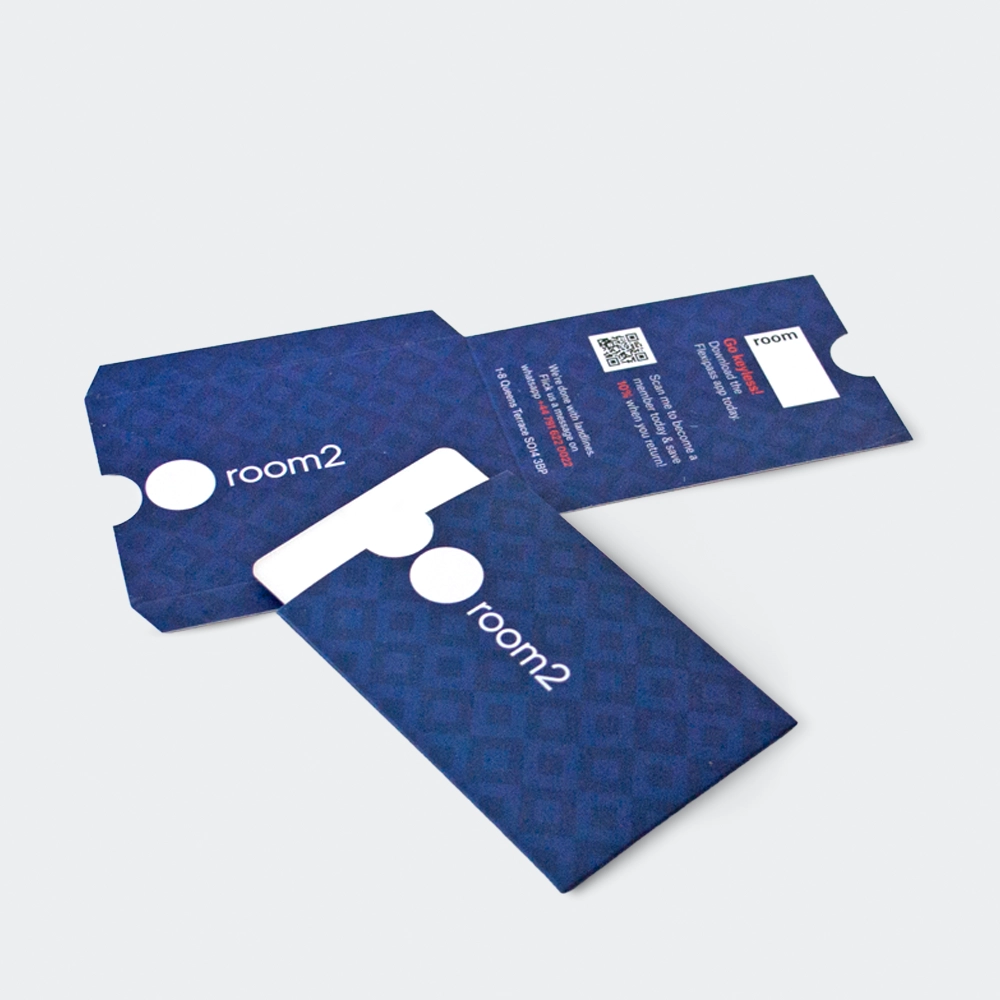
The sleeve that holds a hotel room key does more work than it looks. It protects the card, carries room information, promotes amenities, and shapes a guest’s first impression of the property. Choosing the right paper stock for key card sleeves requires balancing protection, print quality, folding performance, and brand appearance, all within a cost that makes sense at volume. For most properties, a medium-weight matte coated or uncoated cover stock delivers the best combination of those factors. The final choice comes down to three variables: what the brand looks like, how long the sleeve is in use, and whether guests need to write on it.
Start With the Sleeve’s Purpose
Before choosing a paper weight or finish, define what the sleeve actually needs to do. The right material for a sleeve that displays Wi-Fi credentials and checkout instructions differs from one used purely as a branded card carrier.
Common sleeve functions:
- Protecting the card from scratches, bending, or contact with other items
- Displaying room number, Wi-Fi password, or checkout time
- Promoting on-property amenities such as spa, restaurant, or loyalty programs
- Carrying a printed access code or return-by reminder
- Functioning as a lightweight marketing piece for a short-stay guest
Match the paper choice to the sleeve’s primary function. A sleeve designed to be read and discarded in two days has different requirements than one carried throughout a four-night resort stay.
Choose the Correct Paper Weight
Paper weight affects stiffness, folding behavior, tear resistance, perceived quality, and cost. Sleeve stock typically falls in the 170–350 gsm range, with each level suited to different use cases:
| Stock range | Best use | Main trade-off |
| Light cover stock (170–200 gsm) | Economy sleeves, short stays | Lower rigidity and durability |
| Medium cover stock (200–280 gsm) | Most hotels and everyday guest use | Balanced cost and performance |
| Heavy cover stock (280–350 gsm) | Luxury properties, premium presentation | Higher cost, more difficult folding |
Avoid stock that is too thin; it tears during normal card insertion and removal. Avoid stock that is too thick to fold cleanly or fit comfortably in a front desk holder. Confirm the printer’s available weights and folding capabilities before finalizing the artwork.
Matte Coated Stock: Best All-Purpose Option
- Business hotels where the sleeve carries detailed room or amenity information
- Boutique hotels where brand appearance is central but the design is restrained.
- Resorts and multi-property groups running large print volumes
- Sleeves combining photography, branding, and printed guest instructions
Limitations to Know
Matte coated stock has a smooth surface that balances readability with strong color reproduction. The main limitations are minor. Matte stock may show fingerprints or scuffs depending on the specific coating, and its colors are slightly less saturated than full gloss for heavily photographic designs. Matte coated paper is generally writable only if the coating is specifically formulated for pen compatibility; confirm this with the printer before assuming guests can write on it.
Uncoated Stock: Best for Natural and Writable Sleeves
Uncoated paper carries no smooth clay coating on its surface, which gives it a natural, tactile feel and makes it easy to write on with a standard pen or pencil. For properties where staff or guests need to add handwritten room numbers, guest names, or personal notes, uncoated stock is the most practical choice.
Boutique and independent hotels, eco-conscious properties, and rustic or heritage brands where natural texture reinforces the identity all tend to favor uncoated stock. Two performance trade-offs to weigh:
- Colors print softer and less saturated than on coated alternatives
- Heavy ink coverage can affect drying time and surface texture
Gloss Coated Stock: Best for Bold Visual Branding
Gloss coating produces a reflective, smooth surface that maximizes color intensity and image contrast. For sleeves designed around destination photography, vibrant resort imagery, or colorful promotional campaigns, gloss delivers the strongest visual impact of any standard finish. It suits sleeves that function primarily as a marketing piece where color saturation and image sharpness matter more than low glare or handwriting compatibility.
The drawbacks are real. Fingerprints are more visible on a gloss surface, writing with a standard pen is difficult, and dense text under typical hotel lighting creates uncomfortable glare.
Silk or Satin Finish: A Middle Ground
- High-resolution photography alongside detailed guest information
- Dark colors, gradients, or deep-toned brand imagery
- Sleeves that combine strong brand visuals with readable room instructions
Soft Touch Lamination and Specialty Finishes
- Soft touch lamination: Velvety texture, richer-appearing colors, premium tactile feel
- Kraft stock: Natural brown tone suited to eco-focused hotels, farm stays, and outdoor resorts
- Dyed cover stocks (charcoal, deep green, terracotta, sand): Distinctive base for foil or white ink
Kraft and dyed stocks suit restrained, typographic, or single-color design approaches well but reproduce full-color photography poorly. Each is a deliberate material statement, not simply a cost-saving alternative to standard coated stock.
Match Finish to the Artwork
The artwork should drive the finish decision, never the reverse.
Text-Heavy Designs
Choose matte or uncoated stock. Prioritize low glare and high contrast between background and text. Both finishes keep room instructions, Wi-Fi credentials, and amenity details clearly readable.
Photography-Heavy Designs
Choose gloss, silk, or satin. Coated surfaces improve image contrast, color saturation, and overall visual impact. Leave adequate white space around important text blocks so the photography and the information guests need can coexist clearly.
Luxury or Minimalist Designs
Choose heavy matte stock, soft touch lamination, specialty colored stock, or a combination of these. Keep the design restrained so the material and finish remain the focal point. Foil stamping or embossing on heavy stock adds a tactile detail that reads as genuinely premium rather than decorative.
Folding, RFID Compatibility, and Practical Checks
- Fold quality: Does the crease crack, bubble, or delaminate?
- Card fit: Does the key card insert and remove smoothly without catching?
- Stiffness: Does the sleeve hold its shape through normal handling?
- Readability: Is all text clear at arm’s length under typical hotel lighting?
- Writing performance: If guests or staff need to write on it, does a standard pen work?
Paper weight and coating affect how cleanly a sleeve folds and whether the card slides in and out without resistance, so a physical mockup is always worth requesting. For sleeves that include metallic inks, foil, or specialty laminates, confirm with the printer and the access control provider that the material leaves RFID or magnetic stripe function unaffected before committing to the run.
What is the best paper stock for hotel key card sleeves?
Medium weight matte coated cover stock is the most versatile choice for most properties. It combines readability, strong color reproduction, and acceptable durability at a manageable cost. Heavier stocks suit luxury properties; lighter stocks work for short-stay economy use.
Is matte or gloss better for a key card sleeve?
Matte is better for most hotel sleeves. It reduces glare under hotel lighting and keeps text readable. Gloss suits sleeves that function primarily as marketing pieces with large photography and minimal text. Silk or satin handles the middle case: photography alongside readable information.
Is uncoated paper suitable for key card sleeves?
Yes, for the right application. Uncoated stock is ideal when guests or staff need to write on the sleeve, or when the brand values a natural, tactile feel. Colors print softer than on coated stock, so it is less suitable when photography or high-saturation imagery is central to the design.
Takeaway
The right paper stock and finish for a hotel key card sleeve come down to what the sleeve needs to do, what the brand looks like, and how long the sleeve is in use. Medium weight matte coated stock is the safest all-around choice. Uncoated stock suits natural brands and writable applications. Gloss and silk suit photography-led designs. Soft touch and specialty finishes suit luxury positioning.
Plastilam produces custom key card sleeves in a range of stocks and finishes for hotels, resorts, boutique properties, and event venues. Every sleeve is printed, finished, and quality-checked in the United States, with concierge-style service from artwork review through to delivery. Properties that want to match their sleeve stock precisely to their brand and guest experience can request samples, printed proofs, or a direct consultation at Plastilam.
Read More: What Advertising Revenue Can Hotels Generate Through Hotel Key Card Sleeves?